Tuesday, January 16, 2007

Wednesday, January 03, 2007

Kenyans close border with Somalia

Kenya has shut its border with Somalia and will not allow more refugees into the country, says its foreign minister.


Earlier the Kenyan authorities deported more than 420 Somali refugees who had crossed the border in recent days.

The UN refugee agency has condemned Kenya's actions, with aid workers expressing frustration at being unable to help Somalis fleeing conflict.

There have been clashes near the Kenyan border with Islamist militias being pursued by Ethiopian and Somali troops.

Kenya has deployed tanks and helicopters to enforce the border closure.

The recent advance of heavily armed Ethiopian troops has ended a six-month Islamist occupation which had brought a degree of stability to large areas of formerly lawless Somalia.

But the Islamists say their retreat is tactical and have threatened to launch an insurgency.

Refugees

Kenyan Foreign Minister Raphael Tuju told reporters in the Kenyan capital, Nairobi, that they have now asked the transitional government and Ethiopia to establish internally displaced people camps in Somalia.

"We are not able to ascertain whether these people are genuine refugees or fighters and therefore its best that they remain in Somalia," said Mr Tuju.

Mr Tuju also dismissed UNHCR criticism as misguided.

"Kenyans are overburdened, in fact Europe and America does not give us enough aid to support these refugees and it's not a written rule that when there is fighting in Somalia that people should run to Kenya, other nations should also take the burden," he said.

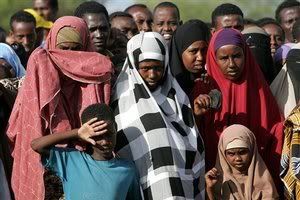
The Somali refugees, mainly women and children, were deported after being taken from the border transit camp at Liboi in north-east Kenya in government trucks.

Earlier, UNHCR spokesperson Millicent Mutuli said the Kenyan Red Cross had been denied access to them for four days.

"It's against international law to deny people access to humanitarian assistance under such circumstances," said Ms Mutuli.

UNHCR head Antonio Guterres said deserving Somali civilians should be entitled to seek asylum in Kenya.

Pursuit

Meanwhile, Ethiopia and Somali government forces, with air support, have captured the Somali border town of Doble, where it is reported that around 4,000 refugees have been stranded.

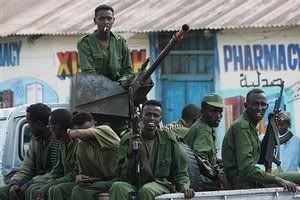
The BBC's Bashkash Jugsodaay in Liboi says that the Islamist militia who formerly held Doble fled late on Tuesday night in about 100 technicals - machinegun-mounted pick-up trucks - carrying an estimated 600 to 700 fighters.

The Somali interim government's spokesman Ali Jama told AFP news agency that their forces were in pursuit of top Islamist leaders in dense border terrain.

"We are yet to pin-point where they are, but we believe they are hiding in the border forest," he said.

Talks

After European members of the Somali Contact group met in Brussels, Swedish Foreign Minister Carl Bildt called for peace talks.

"There has to be a withdrawal of the Ethiopian forces. There has to be a political process, an inclusive political process in Somalia."

The European Union is the largest aid donor to Somalia and has been heavily involved in the mediation process.

Somalia's interim President Abdullahi Yusuf is in Nairobi for talks with diplomats, while Ugandan President Yoweri Museveni is to travel to Ethiopia on Thursday to discuss the possible deployment of Ugandan troops to Somalia.

Uganda is the only country to have made a firm commitment - of up to 1,000 soldiers - towards a planned African peacekeeping force for Somalia.

A deadline of Thursday has been set for Somalis in the capital to hand in their weapons, but the process has begun slowly.

Sunday, December 31, 2006

Vlastimir Dordevic - Wanted


Wanted for War Crimes in the Former Yugoslavia
Vlastimir Dordevic
Up To $5,000,000 Reward


(Son of Stojan)
Born: 17.11.48
Koznica, Vladicin Han
Warrant Date: 02.10.03
Alias: Roda

To bring Dordevic to justice, the United States Government is offering a reward for information.

Individuals who furnish information leading to the arrest or conviction, in any country, of Dordevic or any other indicted war criminal may be eligible for a reward.

In addition to the reward of up to $5 million, informants may be eligible for protection of their identities and relocation for their families.

A reward may also be paid for information leading to the transfer to, or conviction by, the International Criminal Tribunal of an indicted war criminal.

Thursday, December 28, 2006

Opponents of Islamists take Somali capital

By Jeffrey Gettleman
Published: December 28, 2006


NAIROBI: Just hours after the Islamist forces abandoned Mogadishu, the capital of Somalia, militias loyal to the transitional government seized the city Thursday in a stunning reversal of fortunes.


According to residents, troops from the transitional government, along with Ethiopian soldiers who had been backing them up, poured into the capital from the outskirts of the city while militiamen within Mogadishu occupied key positions, like the port, airport and dilapidated presidential palace.

"The government has taken over Mogadishu," a transitional government leader, Jama Fuuruh, told Reuters by telephone from Mogadishu's port.

" We are now in charge."

Mogadishu's new powers immediately had to deal with a rising level of chaos, as armed bandits swept the city and fragmented clan militia began to battle each other for the spoils of war. Witnesses said an intense gun battle raged around a former Islamist ammunition dump and that clan warlords had instantly reverted back to setting up roadside checkpoints and shaking down motorists for money. Many terrified residents stayed in their homes behind bolted doors and the few that ventured into the streets carried guns.

"No one is really in command," said one adviser to Western diplomats who has close contacts with both the Islamists and the transitional government. "Chaos is in command."

People inside Mogadishu and out are stunned. The Islamist forces, just a few weeks ago the most powerful force in the country and considered a regional menace, had disintegrated after just four days of counter-attacks by the Ethiopian-led troops. There were reports that the Islamist leaders had gone underground, fleeing deep into the Somali bush. There were also worries that they had simply changed tactics and could be planning to employ guerilla warfare and terrorist attacks, as they had threatened to do. Today, Sheikh Sharif Sheikh Ahmed, a top Islamist leader, said his forces had surrendered the city to avoid a bloodbath.

"We don't want to see Mogadishu destroyed," he told Al-Jazeera television today by telephone from an undisclosed location.

The Islamist forces hastily collapsed on Wednesday afternoon when clan elders pulled their troops and firepower out of the movement after a string of back-to-back military losses in which more than 1,000 Islamist fighters, most of them adolescent boys, were killed by Ethiopian-backed forces.

"Our children were getting annihilated," said Abdi Hulow, an elder with the powerful Hawiye clan. "We couldn't sustain it."

As the transitional government's troops marched into the city, political negotiations began. Mr. Hulow and other clan elders said they wanted to negotiate with the transitional government to get good positions for fellow clan members in exchange for support. Today, Ali Mohammed Gedi, the prime minister of the transitional government, was meeting with elders from Mogadishu's power clans on the outskirts of the city.

The Islamists started out as a grass-roots movement of clan elders and religious leaders who banded together earlier this year to rid Mogadishu of its notorious warlords, earning them a lot of public support.

But much of that good will seems to have been sapped by their decision to go to war against the transitional government and the Ethiopian forces protecting it.

The Islamists attacked Baidoa, the seat of the transitional government, on Dec. 20; a few days later, they announced that Somalia was open to Muslim fighters around the world who wanted to wage a holy war against Christian-led Ethiopia.

That provoked a crushing counter-attack by the Ethiopians, who command the strongest military in East Africa. For the past week, the Islamists have lost one battle after another, their adolescent soldiers no match for a professional army.

It's rape if the woman is drunk, according to new law

London, Thursday 28.12.06

Men face being charged with rape if they have sex with women who are drunk.

The proposal, contained in a Home Office report, is being considered by ministers in a bid to boost conviction rates for sex offences and bring more “date rapists” to justice.


The new law would mean a woman judged to be drunk at the time of having sex would be deemed incapable of giving her consent. That would potentially open the way for the prosecution of thousands of men for having sex with drunk women — regardless of whether agreement had been given at the time.

Successful prosecutions for rape often founder before they get to court because of the difficulty in proving to juries that a victim had not given consent.

The law change would end that uncertainty and is expected to lead to a huge rise in the current conviction rate of five per cent.

Proof of whether a woman was drunk would come from medical tests — including those taken many hours later using a “back calculating” technique — as well as evidence from witnesses and victims.

The new offence will be proposed in a report on countering date rape by the Home Office's Advisory Council on the Misuse of Drugs.

The report also looks at the role played in sex attacks by drugs such as GHB and rohypnol, which are used by rapists to sedate their victims.

It warns that many attacks are missed because some medical staff fail to realise that rohypnol can be detected up to 36 hours after it was administered — unlike GHB which lasts about 12 hours — and so fail to take tests.

To counter this, it calls for medical guidance to recommend that samples be taken whenever possible. It also recommends the increased testing of victim's hair, which retains drug traces weeks later, and the increased provision of testing kits to enable urine and other samples to be taken swiftly.

At the moment, a drunken woman is deemed to be capable of giving consent so long as she is not unconscious.

This makes it difficult to bring rape prosecutions when the victim has consumed large quantities of alcohol because of the difficulty in countering defence claims that the victim agreed to sex.

The report, to be published shortly, recommends tackling this problem by removing the issue of consent in cases where the victim was inebriated.

Although the council concedes that the wording of a new law will be difficult to achieve, its intention is that the prosecution would be required only to show that the woman — or man — had drunk sufficient amounts to seriously cloud their judgment.

Similar ideas that could lead to a change in the definition of “consent” in rape cases are being considered by the Solicitor General Mike O'Brien as part of a government review designed to tackle low conviction rates.

A spokeswoman said the Home Office would be publishing its plans for increasing the number of successful rape prosecutions, including possible legislative changes, in the New Year.

Wednesday, December 27, 2006

BRYAN DOS SANTOS-GOMEZ - Missing

December 1, 2006
Fort Myers, Florida


DESCRIPTION

Date of Birth: November 3, 2006
Place of Birth: Fort Myers, Florida
Sex: Male
Hair: Black
Height: 2'0" (at the time of his abduction)
Eyes: Brown
Weight: 12 pounds (at the time of his abduction)
Race: White (Hispanic)


THE DETAILS

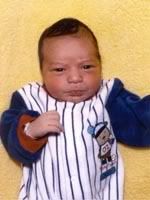
Bryan Dos Santos-Gomez was abducted near his residence in Fort Myers, Florida, during the afternoon of December 1, 2006. An unknown adult female is alleged to be the abductor. (See below.) They are believed to be traveling in a black, two-door SUV with tinted windows.

REWARD

The FBI is offering a reward for information leading to the recovery of Bryan Dos Santos-Gomez.

UNKNOWN SUSPECT

The unknown suspect is described as a heavyset, Hispanic woman with long, straight, black hair. She was last seen wearing blue jeans and a black shirt.


Individuals with information concerning this case should take no action themselves, but instead immediately contact the nearest FBI Office or local law enforcement agency. For any possible sighting outside the United States, contact the nearest United States Embassy or Consulate.

Rwandan businessman pleads guilty to murder at UN war crimes tribunal

14 December 2006 – A former businessman and youth organizer implicated in the 1994 Rwandan genocide will be sentenced next month after he pleaded guilty today before a United Nations war crimes tribunal to the charge of murder as a crime against humanity.


Joseph Nzabirinda

The three judges hearing his case at the International Criminal Tribunal for Rwanda (ICTR), sitting in Arusha in neighbouring Tanzania, accepted the plea of Joseph Nzabirinda, which followed prosecutors’ withdrawal of four other charges against him because of a lack of evidence.

Addressing Judges Arlette Ramaroson of Madagascar (presiding), William Sekule of Tanzania and Solomy Balungi Bossa of Uganda, Mr. Nzabirinda expressed deep remorse for his crimes and asked for pardon from the people of Rwanda for what he had done. The judges set 17 January next year as the date of the sentencing hearing.

Prosecutors said Mr. Nzabirinda, a businessman in the Butare prefecture in southern Rwanda, participated in meetings in 1994 with the notorious Interahamwe militia in which the planned execution of Tutsis in his area was discussed. He also encouraged attacks on Tutsis who had gathered on a hillside and at roadblocks.

During the hearing prosecutors stated Mr. Nzabirinda was an approving spectator during attacks, while his defence counsel agreed that while he had not personally carried out the killings, he had been an accomplice by omission.

Some 800,000 Tutsis and moderate Hutus were murdered, mostly by machete, across Rwanda in just 100 days starting in April 1994. The Security Council set up the ICTR in November that year to prosecute people responsible for genocide and other serious violations of international humanitarian law.

Mr. Nzabirinda also worked as an investigator for the defence team of Sylvain Nsabimana – a former prefect of Butare currently on trial at the ICTR in a separate case with five other accused – until 2001 when his contract was terminated after the Tribunal registry established he had presented false identity documents to obtain employment.

* * * * * * * * * *

NOTE: The movie Hotel Rwanda is based on this genocide.

Friday, December 22, 2006

In Guatemala, hunger's often a part of growing up

Guatemala has the highest rate of malnourished children in the Western Hemisphere, and the government is struggling to reduce the deaths.

By NANCY SAN MARTIN
nsanmartin@MiamiHerald.com
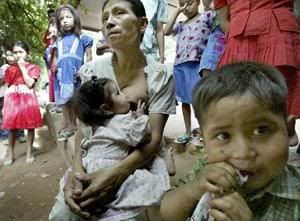


JOCOTAN, Guatemala -- Three-year-old Antonio's patchy skin is thin and saggy, like that of a shrunken old man. But his cries sound more like a newborn's whine. And although his head seems much too large for his frail body, it's actually his body that is too small.

Plopped on a wheelchair because he's too weak to walk, Antonio's crystal black eyes tend to wander until the smell of food penetrates the air and steaming bowls of beans pass before him. Then his mouth starts to salivate and he lets out a desperate whimper.

But Antonio must wait until 10 other hungry children are set up with their meals. Only then can the nurse at the health center focus her attention on feeding the boy who doesn't have the muscle coordination to feed himself.

Weighing about 18 pounds, as much as a 6-month-old baby, Antonio represents one of the worst cases of malnutrition in a country where more than one million children under 5 suffer from the condition.

''Cases such as Antonio's should no longer exist, but the problem remains constant,'' said Dr. Carlos Arriola, director of a health center in this remote village where the boy and other malnourished children are being treated. ``Like Antonio, many others exist.''

Guatemala has the highest rate of malnourished children in the Western Hemisphere, even higher than Haiti, the region's poorest country. The Central American nation also ranks sixth in the world for chronic malnutrition.

The problem usually begins in the womb of mothers who are anemic throughout their pregnancy and give birth to children with low birth weights. More than half of those babies don't make it beyond the age of 5.

''We have many children because we know that some of them are going to die,'' is a phrase often heard by indigenous families in Guatemala's rural communities, where the problem is most prevalent. The indigenous make up about 45 percent of the population in a nation of 13 million.

''There is no reason that this should be happening. Yet, it's been going on for years and years,'' said Manuel Manrique, a representative for the U.N. Children's Fund in Guatemala. ``Part of our task is to make people aware that this is happening and that it is unacceptable.''

ADDRESSING PROBLEM

Two efforts are under way to address the problem: a national program for the reduction of malnutrition and a public awareness campaign called Creciendo Bien or Growing Well. The programs have international support from the United Nations, the U.S.-based Save the Children and other agencies.

Launched in 2004, the goal is to reduce chronic malnutrition for children under age 5 down from the current 49.3 percent to about 25 percent by the year 2016. The initiative is aimed at two types of malnutrition: chronic and acute, which is easier to treat but more life-threatening.

Malnourished children do not grow properly. Often, they are much thinner and shorter than they ought to be for their age.

''Children here don't grow enough,'' Manrique said. ``There is a difference [in height] of 25 percent, compared to other kids in the Americas.''

''It's not just what you see outside, it also affects their brain,'' he said. ``It's a life sentence.''

Factors contributing to the widespread problem are high illiteracy and birth rates, unemployment, scarce fertile land for peasant families to grow their own crops, persistent drought and insufficient government help with cultivation. Unsanitary conditions and contaminated water raises the problem to life-threatening levels for malnourished children.

Malnutrition is most prevalent in mountain villages like Jocotán and Camotán in the department of Chiquimula, east of Guatemala City. Here, most everyone is petite, the result of years of insufficient food. Most families live in adobe homes with thatched roofs and dirt floors and depend on agricultural work. Poor harvests mean few jobs and many empty stomachs.

''There is too little food for so many mouths,'' said Melesia Nufio, 25, the mother of a wispy 1-year-old boy. ``We live off tortillas and coffee.''

The bony-framed Nufio, who has three other malnourished children, is among about 35 women receiving instruction on proper childcare and hygiene as part of a year-old pilot project to stop malnutrition at an early age. A cereal distribution program for children and pregnant mothers also was recently launched.

The women in the program have a combined 75 children, newborn to 6 years old. Most are underweight and several suffer from chronic malnutrition. But the program has been successful in preventing deaths in a community where dying children was common.

''We used to have a child die about every six months,'' said Irma Yolanda Martínez, a community leader. ``Thank God, no child has died of malnutrition since the program began.''

STEADY WORK NEEDED

Even as the assistance is welcome, Martínez said that what is really needed is steady work.

''If we give them food, they'll eat and then the food will be gone again,'' she said. ``An agricultural program would be more beneficial.''

Nufio's family knows the dire consequences of malnutrition. Her mother-in-law Nicolasa Vásquez, has lost two of her nine children. One died at birth, the other as a toddler.

''I don't have enough food to give them all the nutrition they need,'' said Vásquez, 45, as she cradled her youngest child, 7-month-old Jessica.

''We are used to living like this,'' said Vásquez's husband Tereso Casiano. ``It's what God has given us.''

In Jocotán, salvation can be found at two nutrition centers.

The public Center for Nutritional Recuperation opened in 2001 with 70 patients and now treats more than 150 children annually who suffer from chronic malnutrition. Patients, who often display symptoms that include irritability, loss of hair and spotty skin, stay as long as two months while they are fed a ''recuperation'' diet comprised of vitamin-rich formulas and cereals.

But as hundreds of children are nursed back to health, just as many fall ill.

''It remains a constant problem,'' said Dr. Juan Manuel Mejía. ``There is a lot of malnutrition in the countryside and this year, it seems to have grown a bit.''

Children suffering from acute malnutrition, like Antonio, often end up at the Centro de Recuperacion Nutricional Infantil Bethania, simply known as Centro Bethania. Many are on the verge of death by the time they are admitted. Antonio was 15 pounds underweight when he was admitted.

GETTING TREATMENT

The center treats about 400 children each year and on average eight don't survive. It takes at least a month for children to reach up to 80 percent of their ideal weight, said Arriola, the director.

Treatment costs about $900 per child, and though parents are asked to contribute only about $40 of the cost, that is a small fortune in a nation where the distribution income is highly unequal and as much as 75 percent of the primarily indigenous rural population lives on less than $2 per day.

Arriola praised the national initiative as a good first step but added that to successfully combat malnutrition, the effort must be accompanied by ''concrete programs'' that will lower unemployment, increase crop production and improve literacy rates.

He also expressed concern that the national programs would be dropped when a new national government is elected next year.

''What happens when we get a new government?,'' Arriola said. ``Will the state continue to take on the responsibility or is this just going to be a program based on politics?''

Manrique, of UNICEF, blamed politics for previous failed attempts to address malnutrition and criticized limited resources for health and education programs. About 1.8 percent of the GDP goes to health and about 2.9 percent to education.

''This country has a gigantic effort to take on,'' he said. ``With food and other efforts done simultaneously, in a couple of years, we can start to see significant changes.''

The primary focus of the current campaign is to create awareness among the population ''so that these programs are not thrown away once this government is finished,'' Manrique said. ``Knowledge, consciousness and food: those are the three things, properly mixed, that will make change.''

Libya uses HIV children as diplomatic pawns

17 December 2006 09:26


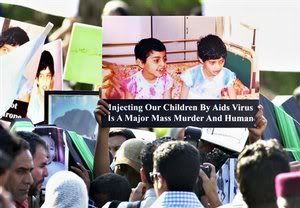
The death in Libya six weeks ago of nine-year-old Marwa Annouiji from Aids was much more than just another developing world statistic. In her short, life, dominated by illness, the frail child was a pawn in a high-level game of international relations.

Marwa, from al-Bayda on the Mediterranean coast, was the 52nd Libyan child to die as a result, Libya claims, of a deliberate operation by foreign medical workers to pump HIV-infected blood into 426 girls and boys at the al-Fatah Hospital in Benghazi.

On Tuesday, barring some extraordinary intervention, the six medics -- a Palestinian doctor and five Bulgarian nurses who have been in prison in Libya for seven years -- will have their sentence confirmed by a court in the capital, Tripoli: execution by firing squad.

The case has sparked unprecedented mobilisation in support of the medics among international scientists who have found the Libyan evidence groundless. European governments and the United States stand accused of abandoning the medical workers for powerful strategic and economic reasons.

"We are still hoping wisdom will prevail," said the head of the nurses' defence team, French lawyer Emmanuel Altit. "The court has not granted the defence its rights, the Libyan evidence in the case is discredited, and the medics' confessions were extracted under mental, physical and sexual torture."

The six -- Dr Ashraf al-Hajuj and nurses Kristiyana Vatcheva, Nasya Nenova, Valentina Siropulo, Valya Chervenyashka and Snezhana Dimitrova -- took up government contracts at the hospital in Libya's second city in March 1998. The first cases of HIV infection were reported the same year. A World Health Organisation report found that the virus had probably been spread because of a lack of proper medical equipment. The six were imprisoned in March 1999.

Libyan courts ordered reports from the world's top Aids scientists and epidemiologists, including Luc Montagnier, one of the discoverers of HIV. Montagnier found the high rate of hepatitis B and C at the hospital suggested that poor hygiene was to blame for the spread of HIV. But the prosecution ignored his report and ordered one from Libyan researchers in 2003.

On May 6 2004, the death sentences were pronounced. On Christmas Day last year, the Libyan Supreme Court ordered a retrial, which led to a new call for the death sentence this August. A verdict is expected on Tuesday.

Children

European doctors who, under a €2-million European Union initiative, have treated the children in Libya, say most are now aged about 12. They suffer from tuberculosis and other Aids-related illnesses.

According to a French Foreign Ministry spokesperson: "They cannot so much as go to the dentist in Benghazi because the Aids stigma is so powerful in Libya. It also appears that, because most of them are outpatients, their parents are not all administering their tablets correctly."

As a result of care problems in Libya, the 374 surviving children are now outpatients at hospitals in Italy and France.

Libyan President Moammar Gadaffi, who is reportedly terrified of dissent in the opposition hotbed of Benghazi, is paying millions of euros for their treatment at the Vatican's Bambino Gesu Hospital as well at French clinics in Lyon, Montpellier, Strasbourg and Toulouse.

Experts on Libya say Gadaffi is using the children as a pawn in his discussions with Western powers over burning issues including contracts for oil, arms and aircraft and diplomatic relations in the Middle East. Gadaffi also remains bitter about the pariah status he acquired after the 1988 Lockerbie bombing. Earlier this year Libya said Bulgaria should pay the families of the children $2,7-billion in compensation -- which is exactly the sum paid by Libya for the 270 lives lost in the Pan Am 103 bombing.

'Pseudo-experts'

International scientists say the 2003 Libyan report was written by "pseudo-experts" and has no value. Last week a paper in Nature magazine by a team led by British evolutionary biologist Oliver Pybus showed that the Benghazi strain of HIV was introduced at the hospital before the arrival of the medics.

Pybus, of Oxford University, said: "By looking at the genome sequence of the virus found in children at Bambino Gesu hospital, we established that the estimated date of the most common recent ancestor for each cluster predated March 1998, sometimes by several years. The virus is of a kind found in West Africa, which makes sense as Libya has a large population of guest workers from there."

The medics' lawyers hope that, even if the death sentences are confirmed on Tuesday, the case will return to the Supreme Court where a judicial council could throw it out for a second time. But Altit said diplomatic efforts to secure the medics' release after more than seven years in jail had been disappointing.

"Libya is coming out of the cold and there are many lucrative contracts in the works. If the sentences are confirmed it will be a disgrace for the European Union. If there is one thing Europe stands for, it is values, such as justice."

A British Foreign Office spokesperson would not comment on the accusation that European governments were sacrificing the medics in the name of trade relations. But he said: "The case is not over yet and we understand it will go to the Supreme Court. The EU has made significant efforts to help the families and upgrade facilities at the hospital. We hope these efforts show that everyone sympathises with the families."

Guardian Unlimited © Guardian News and Media Limited 2006

British police arrest 2nd suspect over prostitute murders


LONDON, Dec. 19 (Xinhua) -- The police arrested a second suspect on Tuesday morning over the murders of five prostitutes in Suffolk, southeast Britain.

A 48-year-old man has been arrested at 5 a.m. at his home in the red light district of Ipswich, where five sex workers used to pry their trade, Sky news reported.


Tom Stephens, a 37-year-old worker with Tesco, the super market, was arrested on Monday by police at his home, southeast of Ipswich where the naked bodies of the women were found.

Stephens, who is now in custody at a Suffolk police station, reportedly told Sunday Mirror on Sunday that he knew all the girls well.


So far there have been no comments on Stephens' arrest. He will be detained for 24 hours and can be held for a further 12 hours with permission from a superintendent and up to 96 hours with permission from the courts.

The naked bodies of five sex workers from Suffolk, aged from 19 to 29, were found in early December in rural areas within 16 km of Ipswich. They were all drug-users.

A total of 412 detectives have been deployed from 36 forces across the country, the biggest ever for a murder investigation.

Light sentence for child rapist

By Laurel J. Sweet
Friday, December 22, 2006 - Updated: 11:12 AM EST


A former religious counselor who blackmailed boys into sex by convincing them he alone had the power to get them adopted will spend just five years behind bars - and only after he enjoys the holidays.

The sentence imposed yesterday on Edward “Brother Tony” Holmes, 65, by Suffolk Superior Court Judge Carol Ball as the result of his guilty plea was half what prosecutors hoped he’d get, but agreed to by his two rape victims because it spared their identities from becoming public at trial.

Ball, who could not be reached to explain her decision, stayed the frail old man’s incarceration until Jan. 8.

Holmes, a former religious brother who worked at the Nazareth Child Care Center in Jamaica Plain 30 years ago, has been living in Washington, D.C.

“Frankly,” Suffolk District Attorney Daniel Conley said, “we may never know how many children Holmes abused.”

Because Holmes left the state in 1990, thus freezing the then-15-year statute of limitations on child sex assault cases, prosecutors were able to indict him last year. He has been free on $15,000 cash bail.

The two victims who finally came forward in 2003 were 9- and 10-year-old trusting wards of the state when Holmes began repeatedly raping them between 1976 and 1983.
Holmes told one victim he’d never let him out to find happiness unless he played along. He first sexually abused the other victim under the guise of comforting him when the child was removed from his family.

Prosecutors are also in possession of dozens of photographs Holmes took of himself having sex with an unknown teenage boy.

Neither known victim appeared in court yesterday. But one told Holmes in a written statement, “I hope you realize the damage you did. I wish I could forgive you, but right now I can’t. I hope you find peace with God.”

Conley said the victims’ well-being was his foremost reason for not fighting Ball.
“Today’s proceedings gave them the satisfaction of seeing (Holmes) admit his crimes and accept his punishment,” Conley said, “without having to provide the wrenching testimony that a trial would have demanded.

“Given their privacy concerns and the challenges inherent in trying a case that reached back 30 years, we accept the judge’s decision.”

lsweet@bostonherald.com.

Welcome to Maine, Baby Jing

Written by Jennifer Osborn
Thursday, December 21, 2006


ELLSWORTH — A Chinese baby girl, abandoned when 6 days old under a highway overpass in Hunan Province, is getting ready to spend her first Christmas with her adopted family on Riverside Lane.


George Russell and Mary Pat Champeau adopted Jing Hui Fan last summer, after more than two years of trying to adopt a child. Jing Hui means “smart” in Chinese.

Millions of Chinese girls have been abandoned as Jing was as a result of China’s population-growth policy, according to Russell. China’s overpopulation problem prompted the government to institute the Planned Birth policy, which varies from rural to urban areas.


“You can’t have a baby unless you get a certificate,” said Russell. Those who have a girl can apply a few months later for a second permit, but “that will be it, no matter what.”

When a woman grows up, her responsibilities shift to her husband’s family, Russell said. Those who have sons consider themselves fortunate because sons will take care of them in their old age.

China has no social welfare programs, Russell said.

“You reach a point where you can no longer provide for yourself and you’ll basically starve,” he said.

“If you’re a girl, you go to an orphanage,” Russell said. “There they sit. After a while, they get a little older and start working in the orphanage and that’s that.”

Mothers leave their babies in heavily trafficked areas, Russell said. Many think the mothers stay and watch until they see a police officer pick up the baby, he said.

Some mothers make a notch in the baby’s ear or some other identifying mark in hopes of someday recognizing their children.

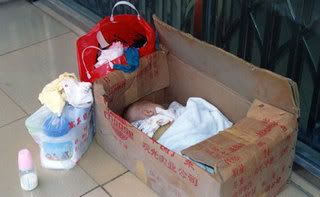
Russell has a photo of an abandoned baby, neatly dressed and swaddled, lying in a cardboard box next to bags of baby clothes, bottles and food.

“Someone has been forced to abandon their daughter in the hopes of getting a permit to have a boy,” Russell said. “In that picture, I think it reflects how hard it is for the mom to let that baby go.”

“If I had one wish, I’d like to tell Jing’s mom that she’s OK,” Russell said. “That she’s loved.”

And loved she is, by Russell and Champeau, siblings Liam, 15, and Claire, 11 — as well as seven cats and three dogs.

Jing looks as if she belongs with the family, which is no coincidence.

The Chinese “read faces” to match children with adoptive families, Russell said. They do this by studying photos of the prospective parents and children.

Russell said the family’s guide told them, “‘She has a long face, just like you, George.’”

Russell and Champeau had asked for and were expecting a child — not a baby — until a few weeks before their departure for China.

“We thought there would be somebody waiting there, starting to lose hope,” Russell said.

Champeau got a call from the adoption agency while Russell was at work, telling her a baby had been found for them.

“‘It’s not like fishing,’” Champeau recalled Russell had said. “‘We can’t throw her back just because she’s too little.’”

“By the time we got her picture a few days later, we were already buying booties and sippy cups,” Champeau said.

Their son Liam, a student at George Stevens Academy, made a film to welcome Jing. It features Hancock County families who have adopted Chinese girls.

At Christmas, Jing and her new family will be visited by relatives.

“…I’m sure she’ll receive many gifts but for us, she is the gift,” Champeau said. “We are crazy about her.”

American adoption of Chinese children is ticking upward.

Last year, 7,906 children were adopted, according to the U.S. Department of State. In 2002, 5,053 were adopted. Russell said there’s a designated line at the Los Angeles Airport for those adopting.

In China, abortions are free, Russell said. But there are laws restricting women from determining the sex of their unborn child.

A new government policy allows a couple to have two children if both the mother and father are only children, according to a report in The Shanghai Daily Tuesday.

The article stated that China’s population would be 400 million higher than it is now without the one-child policy.

Thursday, December 21, 2006

Wanted: Young, pretty, slim parents to adopt orphaned Chinese babies

By JOE McDONALD
The Associated Press


BEIJING — China is imposing new restrictions on foreign adoptions, according to U.S. adoption agencies, barring applicants who are:

• Unmarried

• Obese

• Older than 50

• Taking antidepressants

The restrictions are in response to an enormous spike in applications by foreigners, which has far exceeded the number of available babies, said leaders of American adoption agencies who were briefed this month.

The new regulations, not yet formally announced by the government-run China Center of Adoption Affairs, are expected to take effect May 1 and have raised concern and anxiety among prospective adoptive parents.

China has in recent years been the No. 1 source of foreign-born children adopted by Americans — in fiscal year 2006, the State Department granted 6,493 visas to Chinese orphans — and its regulations on who can adopt have been less restrictive than some other countries.

Now the Chinese government has created guidelines intended to recruit adoptive families with qualities Chinese officials believe will provide the greatest chance the children will be raised by healthy, economically stable parents.

“Their feeling is that while singles can be good parents, it is better for a child to be raised in a two-parent family, it’s better for a parent to be educated, it’s better for a parent not to be obese because they have a chance of living longer. What CCAA really wanted was the cream of the crop,” said Jackie Harrah, executive director of Harrah’s Adoption International Mission in Spring, Texas.

Several agencies said they had been flooded with confused, anxious or disappointed calls and e-mails from people wanting to adopt. Most were told that if they got all their paperwork in by May 1, they likely would be approved. But international adoption agencies have already begun turning away applicants who did not meet the new criteria.

Among China’s new guidelines are that applicants:

• Have a body mass index of less than 40

• Have no criminal record

• Have a high school diploma

• Be free of certain health problems such as AIDS and cancer

Also, couples must have been married for at least two years and have had no more than two divorces between them. If either spouse was previously divorced, the couple cannot apply until they have been married for at least five years.

In addition, adoptive parents must have a net worth of at least $80,000 and income of at least $10,000 per person in the household, including the prospective adoptive child.

Parents can be as old as 55 if adopting a child with special needs.

Timothy Sutfin, executive director of New Beginnings Family and Children’s Services, an international adoption agency in Mineola, N.Y., said the new guidelines put China in the middle of the spectrum — not as restrictive as South Korea, but stricter than Guatemala and Vietnam.

Wednesday, December 20, 2006

Warrant details attack in hotel parking garage

By Zach Lowe
Staff Writer


STAMFORD - As long as Gary Fricker behaved like an armed robber, the woman he assaulted in a downtown parking garage in October was willing to cooperate if it meant keeping her family safe.

The woman, 40, let Fricker go through her wallet as he pointed a handgun at her two children inside the minivan at the Marriott Hotel & Spa, according to an arrest warrant unsealed yesterday.

"Take it, take everything," she told him. "Please leave us alone."

But she protested when Fricker forced her into the back seat and demanded she take her clothes off.

"Come on, don't do this, my kids are here," she told him.

Fricker, 54, went on to sexually assault her while pointing a handgun at her two children, both under 6 years of age, according to the warrant. The assault went on for several minutes, during which Fricker threatened to sexually assault one of her children and slapped her in the face so hard it blurred her vision, according to her statement to police.

Police apprehended Fricker three days later. Two officers tracking purchases Fricker made with the victim's credit cards spotted his van traveling on Interstate 684 near White Plains, N.Y., and chased him down.

He immediately confessed to the attack.

"She will never be the same," Fricker told the arresting officers. "I ruined her life."

Fingerprints found on the minivan match Fricker's, said Capt. Richard Conklin, head of the detective bureau.

Fricker is charged with first-degree aggravated sexual assault, three counts of first-degree kidnapping with a firearm, first-degree robbery and two counts of risk of injury to a minor.

The warrant also shows Fricker was a transient carpenter who did odd jobs around Connecticut and New York, stayed mostly in hotels and bought and sold goods at flea markets and pawn shops.

He had a permit to sell goods at a flea market in Wallingford on Oct. 13, the same day police apprehended him in Ardsley, N.Y.

Fricker, a Danbury native with about 20 arrests and 30 aliases on his record, lingered around the Marriott the day the assault occurred, records show.

A witness, another mother with her children in tow, said Fricker seemed to be following her in the garage about an hour before the Oct. 10 attack, according to the warrant. That woman and the victim picked Fricker out of an eight-person photo lineup.

The victim told police she was "100 percent sure" the man she picked out was the same man who attacked her, according to the warrant.

The victim got Fricker to stop the assault by saying her friend was on the way to the minivan, records show. Fricker then rifled through the victim's purse and stole her cell phone, five credit cards and wallet, which had $1 inside, the warrant says.

The assault started as a robbery, with Fricker approaching the victim from behind after she helped her two children through the sliding door of the minivan, records show. He jabbed the gun into her lower back.

"I think you need to give me all your money," he told her, according to the arrest warrant. "I have a gun."

She went to get her wallet from the front passenger seat as Fricker pointed his gun at her youngest child, the warrant says.

But Fricker suddenly expressed concern the woman would follow him if he let her go, then he forced her into the back seat and sexually assaulted her, according to the warrant. He walked away when a car pulled up and the victim started screaming.

Police arrived, and the detective bureau started an around-the-clock investigation that involved monitoring the victim's cell phone and credit cards in case the suspect used them.

Fricker made purchases with the stolen cards at six locations in Stamford, Westchester County, N.Y., and the Bronx, N.Y., over the next three days, including at the City Limits Diner on the city's West Side about an hour after the attack, records show.

Police stayed in constant touch with credit card companies to track the purchases, said Capt. Richard Conklin, head of the department's detective bureau.

Every time they learned of a purchase, they went to the scene, seized security tapes and exchanged information with local police, Conklin said.

Officers David Rodriguez and Angel Gonzalez were on their way to meet officers in Westchester County on Oct. 13 when detectives got a real-time hit: Fricker was trying to use one of the credit cards in Brewster, N.Y.

Rodriguez and Gonzalez pulled into a police turnaround area on Interstate 684 and waited for Fricker's 1994 gray Dodge Ram van.

They followed Fricker on a 20-minute high-speed chase before New York state troopers bumped his vehicle off the road. A search of Fricker's car turned up job invoices from recent work in New Haven, 16 pairs of eyeglasses and a card key for a hotel in Elmsford, N.Y., records show.

It is unclear where Fricker stayed in the nights after the attack. He has family in Stratford and other connections in New York, police said.

Fricker is scheduled to appear in state Superior Court on Dec. 19. He also is wanted for arson in Holly Hill, Fla., where police say he skipped parole after burning down his own apartment to get revenge on a woman.

Holly Hill police have said they plan to press charges against Fricker.

Update:
Stamford Rape Suspect Pleads Not Guilty

Judge Deciding Fate of Little Xctasy & Her Older Brothers

Dec 20, 2006 12:58 PM


The couple accused of severely beating a 4-year-old girl may lose custody of their children.

A Family Court is reviewing one of Schenectady County's worst cases of child abuse.

Delia Hernandez, and her 25-year-old boyfriend, Jose Munoz, allegedly broke the arm of Hernandez's daughter, Xctasy Garcia. Police say they also burned her with cigarettes when she would not obey them inside the Schenectady hotel they were living in - and even held a bleach soaked rag to the child's eyes.

The couple faces child abuse charges and could be facing up to 25 years in prison if convicted.

Today, a judge is deciding where Xctasy and her two older brothers, ages seven and eight, should be placed. They have been living in foster care since June.

The biological father of 8-year-old Hennesy Velazquez is fighting for custody as well. Luis Velazquez has been trying to secure full custody of his son.

Xctasy's mother wants her children to stay together and custody granted to her sister.

The hearing is slated to begin at 1 o'clock this afternoon.

Police investigate child abuse in northern town

By Matthew Moore

An investigation has been launched into the targeting of teenage girls in Oldham, Greater Manchester, by a group of local paedophiles.

As many as 20 girls - some as young as 12 - are thought to have been abused by older men who buy them gifts and pose as their "boyfriends", before turning the relationship sexual.

More than 20 people have already been arrested, and five people have been charged with offences including abduction and rape.

Greater Manchester Police have described the abuse as a major problem but say they have no evidence that it is the work of an organised paedophile ring.

The abusers typically prey on girls they do not know, approaching them in public places. They offer gifts of mobile phones and electronic gadgets to gain their victims' trust, before plying them with drink and drugs.

It is alleged that the girls - a small number of whom are in local authority care - end up being physically harmed or forced into sex.

The joint inquiry is being carried out by police, Oldham council, Oldham Primary Care Trust and the charity Barnardos.

Friday, December 15, 2006

British military inquiry rejects Kenya rape claims

Press Association
Thursday December 14, 2006
Guardian Unlimited


An inquiry into allegations that British soldiers raped more than 2,000 Kenyan women found no reliable evidence to support a criminal prosecution, the government said today.

The investigation, carried out by the special investigation branch of the Royal Military police, examined the claims and found much of the evidence cited in the cases appeared to have been fabricated.

In a statement today, the Ministry of Defence said the 10-month investigation had concluded there was "no corroborative evidence that would lead to the successful prosecution of a named individual in a UK court".

Impact, a human rights group representing Maasai women in the case, said it would continue its attempts to have the accused men prosecuted.

"There are a number of cases with concrete evidence, and even if the British write a hundred reports, justice must be done," the organisation's Johnson ole Kaunga said.

"They seem to be saying rapes took place but they can't find who did it. They have spent three years and millions ... just to tell us what they have always said. This is a joke."

Mr. Kaunga said Kenyan police were conducting a parallel investigation, but were not available for comment.

The Royal Military police interviewed 2,187 mostly Maasai and Samburu tribeswomen who said they had been sexually assaulted by British troops training in Kenya.

"A large amount of the information provided by the Kenyan police and medical authorities appears to have been fabricated," a spokesman for the MoD said.

The investigation also examined claims that "institutional acquiescence" had led to rape complaints being ignored by the army, but again concluded that there was no case to answer.

The allegations, which date back over 55 years, arose in summer 2003 when several women demonstrated outside the British high commission in Nairobi, claiming their mixed race babies were the result of rapes by British soldiers.

The Adjutant General, Lieutenant General Freddie Viggers - the army's principal personnel officer - said: "The British army has taken these allegations extremely seriously, and they have been extensively and sensitively examined.

"It has been a complex and detailed investigation which has been subject to rigorous internal and external reviews, and all viable lines of inquiry have been pursued."

There are concerns that the findings, which were independently verified by Devon and Cornwall police, will strain relations between Britain and the Kenya, where up to 4,000 British troops undergo training each year.

Gen. Viggers thanked the Kenyan authorities for their cooperation with the inquiry. "The British army greatly values the opportunity to train in Kenya, and we look forward to continuing our strong relationship with our Kenyan counterparts," he said.

Monday, December 11, 2006

Teen sentenced to 90 years for brutal attack


A 17-year-old suburban teen was sentenced Monday to 90 years in prison in the brutal attack of a Hispanic boy who was beaten, kicked, stomped, burned and sodomized with the plastic pole of a patio umbrella.

Keith Turner was the second teen convicted of aggravated sexual assault in the April attack at a house in Spring, north of Houston. David Henry Tuck, 18, was convicted and sentenced to life in prison on Nov. 16.

Turner was convicted late Friday after about 90 minutes of deliberations. The jury took about five hours over two days to reach the sentence of 90 years.

Turner will have to serve at least 30 years before becoming eligible for parole.

Although Turner was the younger of the assailants and didn’t have the history of racial attacks that colored Tuck’s past, it was his idea to use the patio umbrella pole in the attack.

Turner, Tuck, the victim and two other teens were partying at a house in Spring, drinking and taking cocaine and Xanax. Twelve-year-old Danielle Sons, who was at the party at her house, told the other boys that the victim had tried to kiss her, prompting the attack.

Tuck shouted racial slurs and “white power” as he and Turner kicked the then 17-year-old, cut him with a knife, sodomized him with a plastic pipe and poured bleach on him in an assault that lasted up to five hours. The victim was left bleeding in the backyard until dawn, when Sons and her brother, Gus, finally woke their mother, who slept through it.

During Turner’s trial, jurors saw a videotaped statement by Turner in which he admitted to being the first one to grab the umbrella pole and joking about using it to sodomize the victim.

Sunday, December 10, 2006

Trafficked from Pakistan, raped and jailed in Saudi Arabia

Mazhar Abbas
AFP
April 25, 2006


KARACHI, Pakistan -- Sixteen-year-old Isma Mahmood was deported to Pakistan last month after serving six months in shackles and handcuffs in a prison in Saudi Arabia. Her crime: being raped by a Saudi man.

"It's difficult for me to talk about what happened to me, from rape to prison and from prison to deportation," Isma said in the office of a rescue trust in Karachi where she sat with her sister Muna, 18, who was also deported.

Isma's parents, originally from the central Pakistani city of Multan, were trafficked to Saudi Arabia around 20 years ago. "Though both of us were born there, we are Pakistanis," Isma said.

Human rights groups say that hundreds of people, particularly young women, are still trafficked from South Asia every year, with many going on to face a life blighted by physical and often sexual abuse.

In Isma's case, being born in Saudi Arabia was no help when she was raped last year in the holy city of Medina.

"I was the victim, I was raped and molested but I was named as the accused, and the man who committed the crime was not touched," she said, hiding her face with both hands in shame.

"He first kidnapped me, dragged me into his car," Isma said. "At first he asked me to sleep with him and offered good money. When I refused and tried to resist, he warned me of dire consequences and raped me in the car."

The unnamed man warned her that she would be imprisoned if she went to police, and said that the Saudi sponsor who brought her parents to the country through a Pakistani agent would have them all expelled.

"I am very powerful and could declare you a bad girl. Your father's sponsor is my friend and he will not support you," she quoted the man as telling her.

The sponsor, too, threatened Isma and Muna, warning that they would be punished unless they kept silent, she said, asking that the sponsor's name not be revealed to spare her family any additional grief.

"I and my sister thought otherwise and we went to police as we expected justice. But after a few hours of filing the report the police allegedly changed it," Isma said.

Under pressure from the Saudi sponsor, Isma's parents asked her to withdraw her allegations.

"I never wanted my parents to get into trouble as they were at the mercy of the sponsor and he lived in our neighborhood. So I did not speak much but police still put me behind bars," she said.

"My sister Muna tried to help me out but was also arrested and put into prison only because she spoke for me. They don't support immigrants and protect Saudi nationals," she said. "They never told us what the charges were."

Once in jail, their nightmare began in earnest, Isma said.

The women prisoners were mostly Pakistanis, Indonesians, Bangladeshis and Nigerians. Most of them came to Saudi Arabia through trafficking networks and were charged with prostitution, she said.

"No one would believe what it was like," Muna said.

"When I used to protest against the ill treatment they beat me on my back," Isma added. "We were chained all during this period. The only time jail officials removed the chain was during lunch or when anyone went to the bathroom or at prayer time," she said.

"Once a jail official offered me help and assured me I would be released if I agreed to sleep with him ... There was a Pakistani woman who was over 40 years old and developed Aids in prison, but she remained in chains before she was deported to Pakistan," she added.

Isma and Muna are now in the care of the Ansar Burney Trust, which deals with most of the hundreds of Pakistanis who are deported from the Middle East every year.

"It's pathetic that all this happened with Isma at the hands of a fellow Muslim," the trust's president Ansar Burney said.

Burney says that many poor women and girls from South Asia are lured with promises of good money working as maids or nurses, but their Arab sponsors and Pakistan agents later force them into prostitution.

Anyone who talks about the abuse faces the same fate as Isma and Muna, he said.

Pakistan in January arrested three people who ran a travel agency that allegedly sent young girls to the United Arab Emirates and other countries through fraudulent means, where they were forced into prostitution, officials said.

"The traffickers act like mafia and have contacts in the law enforcement and intelligence agencies, and if their photographs, names or details came in the media the girls' safety comes under threat," Burney said.

"They first put advertisements in newspapers, asking for maids or nurses and offer them good salaries. After interviews they arranged their passport, visa and other traveling documents through travel agents, who, too, in many cases were part of the gang," Burney said.

Some girls are also trafficked into Pakistan, Burney said, especially from Bangladesh.

"The government has failed to check the smuggling of children and women as they are not serious about proper legislation," said Anis Haroon, president of Pakistan's Aurat (Women) Foundation.

Jailed for being raped

Under the Hudood Ordinances promulgated by General Zia ul Haq in 1979. a woman or girl who reports a rape is liable to find herself accused of the serious offence of zina - adultery. The rape survivor is assumed guilty of 'illicit sexual intercourse' unless she can prove innocence. This requires producing, as witnesses to the act, four Muslim adult males of good character.

In 1984 a 15-year-old parentless girl called Jehan Mina was raped by her uncle and her cousin while staying at their home to tend her sick aunt. Later, when she showed signs of pregnancy, she confessed to another uncle that the rape had occurred. He went to the police and a case was set in motion. Jehan Mine had to be protected from the accused uncle and her grandfather who wanted to Kill her.

When the case came to trial the accused men were acquitted. Not surprisingly there were no 'tour adult male witnesses to the crime. And the court found that the men could not be punished merely on the basis of Jehen Mine's statement, which had thrown the entire blame of adultery on the 'other two co-accused'. Her pregnancy was seen as a confession of zina and she was sentenced to 100 lashes, the maximum penalty.

On appeal the sentence was mitigated to three years' imprisonment and 10 lashes. She was not acquitted because the court found It unsatisfactory that she had waited until her pregnancy became apparent to make the accusation against her uncle.

Jehan Mine served her sentence and gave birth to her child in jail. Although no woman has since been sentenced to the maximum penalty for adultery, the number of imprisonments under the Hudood Ordinances is rising: 738 In 1990, compared to 503 in 1984.

Maria del Nevo in Lahore.


More:
Sabbah's Blog